
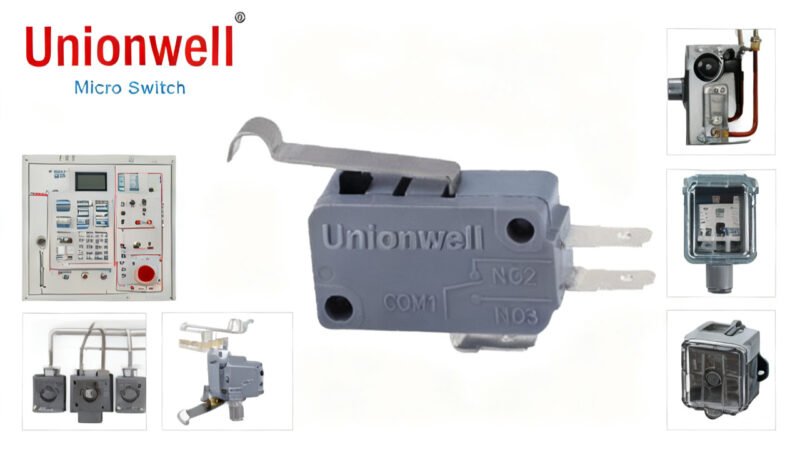
In the intricate machinery of modern industry, small components often play the most critical roles. Among these, micro switches stand out as indispensable elements, dictating precision, safety, and operational efficiency across countless applications. For engineers, product developers, and procurement specialists, understanding the nuances of these vital components, from standard micro switches to specialized limit and waterproof variants, is paramount. Partnering with a reputable micro switch manufacturer like Unionwell ensures access to components that meet stringent quality and performance standards.
Understanding the Core: What is a Micro Switch?
A micro switch, often referred to as a miniature snap-action switch, is a compact electrical component characterized by its highly sensitive actuation and rapid, decisive switching action. It employs a spring-loaded lever mechanism that, when activated by a small amount of force, quickly changes the state of its electrical contacts. This ‘snap-action’ ensures minimal arcing and provides a clear, tactile, and audible feedback, making it ideal for applications requiring precise and reliable on/off control.
These switches are renowned for their durability, high repeatability, and ability to handle various electrical loads. Their compact size allows for integration into tight spaces, making them pervasive in everything from consumer electronics to heavy industrial machinery. The reliability of a unionwell micro switch, for instance, is a testament to meticulous design and manufacturing processes, ensuring consistent performance over millions of cycles.
The Pivotal Role of a micro switch manufacturer
The quality of a micro switch directly impacts the reliability and safety of the end product. This underscores the importance of selecting an experienced and quality-driven micro switch manufacturer. A leading manufacturer brings several key advantages to the table:
- Engineering Expertise: Deep understanding of contact physics, material science, and mechanical design to optimize switch performance and longevity.
- Rigorous Quality Control: Adherence to international standards (e.g., UL, CE, RoHS) through comprehensive testing protocols, ensuring consistent product quality and compliance.
- Customization Capabilities: Ability to design and produce switches tailored to specific application requirements, including unique operating forces, terminal types, and environmental resistances.
- Innovation: Continuous research and development to introduce new technologies, such as enhanced sealing for harsh environments or improved contact materials for specific electrical loads.
- Supply Chain Reliability: Consistent availability of components and efficient logistics to support production schedules.
A manufacturer that excels in these areas provides not just a component, but a reliable solution that contributes to the overall success of a project.
Limit Switches: Guardians of Mechanical Motion
While all micro switches provide a switching function, the limit switch is a specialized variant primarily used to detect the presence or absence of an object, or to monitor the limits of mechanical motion. These robust electromechanical devices are fundamental to automation and safety systems, acting as sensors that respond to physical contact.
Common applications for limit switches include:
- Position Sensing: Determining if a door is open or closed, a part is in place, or a machine arm has reached its endpoint.
- Safety Interlocks: Preventing machinery from operating if safety guards are not correctly positioned.
- Counting and Sequencing: Tracking the movement of parts on a conveyor belt or within an assembly line.
- Over-travel Protection: Stopping a machine before it exceeds its safe operational limits, preventing damage to equipment or injury to personnel.
Limit switches are typically built to withstand demanding industrial environments, featuring robust housings and precise actuation mechanisms. Their reliability in detecting specific physical conditions makes them indispensable in factory automation, robotics, elevators, and material handling systems.
Conquering Harsh Environments: The waterproof micro switch
Many industrial and outdoor applications expose electronic components to moisture, dust, and corrosive agents. In such scenarios, a standard micro switch simply won’t suffice. This is where the waterproof micro switch becomes critical. Engineered with enhanced sealing mechanisms, these switches are designed to operate reliably in challenging environments, preventing ingress of liquids and particulates that could cause short circuits, corrosion, or mechanical failure.
Key features of a high-quality waterproof micro switch include:
- IP Ratings: Conformance to Ingress Protection (IP) standards (e.g., IP67, IP68), indicating resistance to dust and water immersion.
- Sealing Materials: Use of durable elastomers, epoxy potting, or specialized housing designs to create an impenetrable barrier.
- Corrosion Resistance: Materials selected to resist chemical degradation in harsh atmospheres.
- Temperature Stability: Ability to maintain performance across a wide range of operational temperatures.
Applications for waterproof micro switches are diverse, spanning automotive systems (door latches, engine compartments), marine equipment, outdoor lighting, agricultural machinery, medical devices that require sterilization, and various industrial equipment exposed to washdowns or extreme weather conditions. Choosing a reliable Unionwell waterproof micro switch ensures operational integrity and extends the lifespan of the equipment in such demanding settings.
Selecting the Right Switch for Your Application
When specifying micro switches, whether standard, limit, or waterproof, several factors must be carefully considered:
- Electrical Requirements: Voltage, current rating, and contact configuration (NO, NC, SPDT).
- Operating Force: The force required to actuate the switch, critical for sensitivity and user experience.
- Mechanical Life: The number of operational cycles the switch is guaranteed to perform.
- Environmental Conditions: Temperature range, presence of dust, moisture, or corrosive agents. This is where a waterproof micro switch excels.
- Form Factor and Mounting: Physical dimensions and how the switch integrates into the product design.
- Actuator Type: Pin plunger, lever, roller lever, etc., depending on the actuation mechanism.
- Certifications: Compliance with relevant industry standards (e.g., UL, CUL, ENEC, CQC) for safety and performance.
Partnering with a knowledgeable micro switch manufacturer allows for expert guidance through this selection process, ensuring the chosen component perfectly matches the application’s needs.
Conclusion
Micro switches, in their various forms, are fundamental to the functionality, safety, and efficiency of countless industrial and consumer products. From the precise snap-action of a standard unionwell micro switch to the robust position sensing of a limit switch, and the resilient protection offered by a waterproof micro switch, these components are silent workhorses enabling technological advancement. For businesses seeking to develop reliable, high-performance systems, collaborating with a trusted and experienced micro switch manufacturer is not just an option, but a strategic imperative. It guarantees access to components that not only meet but exceed the rigorous demands of modern industrial control.