
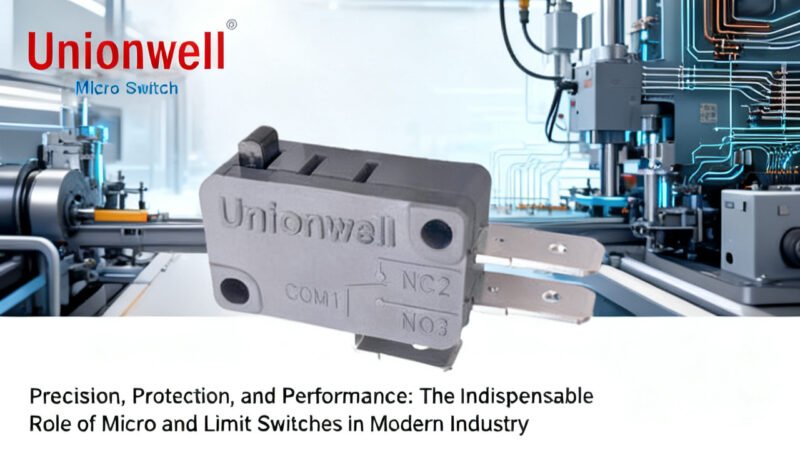
In the intricate world of industrial automation and advanced machinery, the smallest components often play the most critical roles. Among these, micro switches and limit switches stand out as foundational elements, ensuring precision, safety, and reliable operation across a vast spectrum of applications. Understanding their capabilities, variations, and optimal selection criteria is paramount for engineers and procurement specialists seeking to build robust and efficient systems.
At their core, a micro switch is a small, highly sensitive snap-action switch designed to detect the presence or absence of an object, or to confirm a specific position. Characterized by their rapid change of state (snap-action mechanism), these switches provide precise and repeatable switching operations, making them ideal for applications where accuracy is non-negotiable. They typically feature a small operating force and a short travel distance, ensuring quick response times and minimal mechanical stress.
- Precision Detection: Essential for accurate position sensing in intricate mechanisms.
- Rapid Actuation: The snap-action mechanism ensures a quick and definitive make-or-break contact.
- High Repeatability: Consistent actuation points over millions of cycles.
- Compact Design: Allows integration into confined spaces within machinery.
From controlling the functionality of household appliances to serving as critical safety interlocks in industrial machinery, micro switches are ubiquitous. Their versatility stems from a wide array of actuator types, including pin plungers, hinge levers, roller levers, and simulated roller levers, each suited for different mechanical interactions.
Limit Switches: The Industrial Guardian of Motion
Often considered a robust evolution of the micro switch, a limit switch is specifically engineered for industrial environments to detect the presence or absence of an object, or to monitor the limits of its travel. These switches are typically housed in rugged enclosures, protecting them from physical impact, dust, and moisture, making them suitable for heavy-duty applications. Limit switches are indispensable for:
- Position Sensing: Confirming the end-of-travel for moving parts in conveyors, machine tools, and robotics.
- Safety Interlocks: Preventing machinery from operating outside safe parameters.
- Sequence Control: Initiating or stopping operations based on the position of a component.
- Counting and Timing: Providing signals for automated counting or timing functions.
Their robust construction often includes metal housings, reinforced actuators, and sealed cable entries, ensuring reliable performance in challenging industrial settings where standard micro switches might fail. The choice between a micro switch and a limit switch often comes down to the environmental demands and the required level of mechanical durability.
Conquering the Elements: The Rise of waterproof micro switches
In environments exposed to liquids, dust, or extreme humidity, standard switches are prone to failure. This is where waterproof micro switches become indispensable. Engineered with specialized sealing mechanisms, such as O-rings, epoxy potting, and ultrasonic welding, these switches are designed to prevent ingress of contaminants, ensuring uninterrupted operation and extending the lifespan of equipment.
Key Advantages of Waterproof Micro Switches:
- Enhanced Durability: Protection against water, oil, chemicals, and fine dust particles.
- Increased Reliability: Prevents short circuits and corrosion in adverse conditions.
- Wider Application Scope: Enables use in outdoor machinery, marine equipment, food processing, and medical devices.
- Compliance: Often meet stringent IP (Ingress Protection) ratings, such as IP67 or IP68, signifying high levels of protection against immersion.
For applications ranging from automotive door latches and industrial cleaning equipment to outdoor security systems and agricultural machinery, waterproof micro switches are not just an option but a necessity, safeguarding operational integrity and reducing maintenance costs.
Strategic Selection: Factors for Choosing the Right Switch
Selecting the optimal micro or limit switch requires a comprehensive understanding of the application’s specific demands. Key considerations include:
- Electrical Ratings: Ensure the switch can handle the required voltage and current (AC/DC) for both resistive and inductive loads. Overlooking this can lead to premature failure.
- Operating Force & Travel: Match the switch’s operating force to the available mechanical force from the actuating mechanism. Consider the pre-travel, over-travel, and differential travel for precise control.
- Mechanical & Electrical Life: Evaluate the expected number of cycles. High-quality switches are rated for millions of mechanical operations, ensuring longevity in high-frequency applications.
- Environmental Conditions: Assess temperature range, presence of dust, moisture, chemicals, vibration, and shock. This directly impacts the need for sealed or ruggedized versions (e.g., IP-rated switches).
- Actuator Type: Choose an actuator (e.g., pin plunger, roller lever, hinge lever, flexible rod) that best suits the physical interaction with the target object.
- Mounting Configuration: Consider panel mount, PCB mount, or chassis mount options, along with terminal types (solder, quick connect, screw).
- Material Compatibility: Ensure the housing and contact materials are suitable for any chemical exposures.
- Certifications: Verify compliance with relevant industry standards such as UL, CE, RoHS, and others pertinent to the application’s region or industry.
Broadening Horizons: Applications Across Industries
The versatility of micro and limit switches makes them indispensable across virtually every industrial sector:
- Automotive: Door latches, seat belt detection, gear shift position, power window control.
- Industrial Machinery: Robotics, CNC machines, conveyors, packaging equipment, safety gates.
- HVAC Systems: Airflow detection, damper control, pressure sensing.
- Medical Devices: Equipment interlocks, fluid dispensing, patient bed controls.
- Consumer Electronics: Appliance door interlocks, power tools, vending machines.
- IoT & Smart Devices: Position sensing in smart home devices, automated blinds.
Their ability to provide reliable feedback and control signals forms the backbone of modern automation, contributing significantly to efficiency, safety, and precision.
The Manufacturer’s Edge: Quality and Innovation
Partnering with a specialized micro switch manufacturer is crucial. A reputable manufacturer offers not only a wide range of standard products but also possesses the engineering expertise to provide customized solutions for unique applications. They ensure stringent quality control, consistent performance, and adherence to international standards, backed by robust research and development capabilities to meet evolving industry demands. This commitment to quality translates directly into the reliability and longevity of the systems they support.
Conclusion
Micro switches, limit switches, and their waterproof counterparts are far more than simple components; they are critical enablers of modern industrial and consumer technology. Their precision, durability, and adaptability ensure the seamless operation and safety of countless devices and systems. By carefully considering the technical specifications and environmental demands of each application, engineers can leverage these small but mighty devices to achieve optimal performance, reliability, and innovation in their designs.