
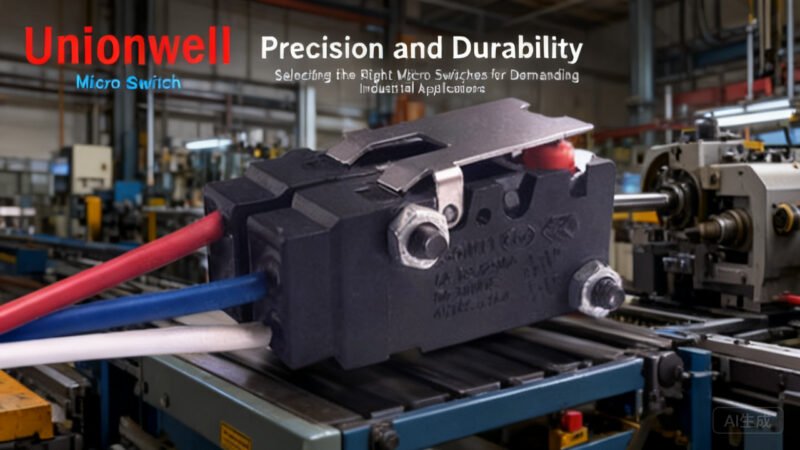
In the intricate world of industrial automation and control systems, seemingly small components often play the most critical roles. Among these, the micro switch stands out as a fundamental device, instrumental in ensuring the precise operation, safety, and reliability of countless machines and applications. For engineers, product designers, and procurement professionals, understanding the nuances of micro switches—from their basic functionality to advanced environmental sealing—is paramount to selecting the right component that will perform flawlessly under demanding conditions.
At its core, a micro switch, also known as a miniature snap-action switch, is an electromechanical device designed to open or close an electrical circuit with a rapid, decisive action. This “snap-action” mechanism is its defining characteristic, providing a quick change of state regardless of the speed of actuation. This rapid switching minimizes arcing and extends the electrical life of the contacts, making them highly reliable for repetitive operations. Typically, a micro switch consists of a plunger or lever actuator, a contact mechanism (usually normally open, normally closed, or changeover), and a robust housing.
The Indispensable Role of Micro Switches in Industry
Micro switches are ubiquitous across a vast spectrum of industrial sectors, acting as critical sensing and control elements. Their ability to deliver precise, repeatable action with high durability makes them ideal for:
- Position Sensing: Detecting the presence or absence of a component, the end-of-travel of a moving part, or the opening/closing of a door or gate.
- Safety Interlocks: Ensuring machinery only operates under safe conditions, preventing accidents by cutting power when guards are open or components are misaligned.
- Process Control: Initiating or terminating operations based on specific mechanical inputs, such as liquid levels, pressure thresholds, or material flow.
- User Interface: Providing tactile feedback in control panels, joysticks, and push-button arrays.
Key Types and Considerations for Industrial Environments
While the basic principle remains the same, micro switches come in various configurations tailored for specific applications and environmental challenges:
Standard Micro Switches
These are the foundational switches, offering a balance of performance, size, and cost. They are suitable for general-purpose applications where environmental factors are benign and moderate electrical loads are present. Key considerations include operating force, actuator type (pin plunger, hinge lever, roller lever), and contact configuration.
Limit Switches
A specialized form of micro switch, limit switches are engineered for heavy-duty industrial applications, particularly for position detection in machinery. They typically feature robust housings (often metal), a wide range of interchangeable actuators (rotary, plunger, wobble stick), and higher electrical ratings. Limit switches are designed to withstand significant mechanical stress, vibration, and often harsh environmental conditions, making them indispensable in manufacturing lines, robotic systems, and material handling equipment.
Waterproof and Sealed Micro Switches
For environments exposed to dust, moisture, oil, or corrosive chemicals, waterproof micro switches are essential. These switches feature enhanced sealing mechanisms, often utilizing O-rings, epoxy potting, or specialized housing designs, to achieve specific Ingress Protection (IP) ratings (e.g., IP67, IP68). An IP67 rated switch, for instance, is fully protected against dust ingress and can withstand temporary immersion in water. Selecting a waterproof micro switch is critical for applications in outdoor equipment, food processing, marine environments, and any setting where environmental contaminants could compromise switch integrity and operational safety.
Other Specialized Micro Switches
- High-Temperature Switches: Designed to operate reliably in extreme heat conditions, often found in ovens, furnaces, or engine compartments.
- Low-Force Switches: Requiring minimal actuation force, ideal for delicate sensing applications or human-machine interfaces where light touch is preferred.
- Safety Switches: Engineered to meet specific safety standards, often with positive opening contacts, ensuring that the circuit is definitively broken even if contacts weld.
Critical Selection Criteria for B2B Buyers and Engineers
Choosing the optimal micro switch involves a detailed evaluation of several technical specifications to ensure compatibility, reliability, and longevity within its intended application:
- Electrical Ratings: Match the switch’s voltage and current ratings (AC/DC) to the circuit’s requirements. Consider inductive, resistive, or capacitive loads, as these affect contact wear and switch life.
- Operating Force & Travel: The force required to actuate the switch and the distance the actuator travels. This must align with the mechanical input available from the application.
- Actuator Type: Select an actuator (e.g., pin plunger, short hinge lever, roller lever, simulated roller lever) that interfaces correctly with the moving part it’s monitoring.
- Contact Material: Different contact materials (e.g., silver alloy, gold plating) are optimized for various electrical loads and environmental conditions. Gold plating, for instance, is excellent for low-current applications where contact resistance must be minimized.
- Environmental Durability: Beyond basic IP ratings, consider resistance to shock, vibration, extreme temperatures, and chemical exposure. A robust micro switch manufacturer will provide detailed environmental specifications.
- Mechanical & Electrical Life: The expected number of operations before failure. Industrial applications often demand millions of cycles.
- Mounting & Form Factor: Ensure the switch’s dimensions and mounting configuration are compatible with the available space and installation method.
- Certifications: Verify that the switch meets relevant industry standards and safety certifications (e.g., UL, CE, RoHS, CCC) for the target market.
- Reliability and Manufacturer Reputation: Partnering with a reputable micro switch manufacturer is crucial. A reliable supplier offers consistent quality, technical support, and product availability, which can significantly impact project timelines and long-term system performance.
Applications Across Industries
The versatility of micro switches makes them indispensable in numerous sectors:
- Automotive: Door latches, seat belt sensors, gear shift interlocks.
- Industrial Machinery: CNC machines, robotics, conveyors, packaging equipment, safety gates.
- Medical Devices: Patient beds, diagnostic equipment, surgical tools.
- HVAC Systems: Damper control, fan speed detection.
- Security Systems: Door/window sensors, access control.
- Consumer Electronics & Appliances: Though B2B focused, their principles extend to everyday items like microwaves and washing machines, influencing industrial component design.
Conclusion
The selection of a micro switch is far more than a minor procurement decision; it is a critical engineering choice that directly impacts the performance, safety, and longevity of industrial equipment. By meticulously evaluating the electrical, mechanical, and environmental requirements of an application, and by collaborating with an experienced micro switch manufacturer, engineers can confidently specify components that will deliver unwavering precision and durability. Investing in the right micro switch ensures not only optimal operational efficiency but also safeguards against costly downtime and potential safety hazards in the demanding landscape of modern industry.