
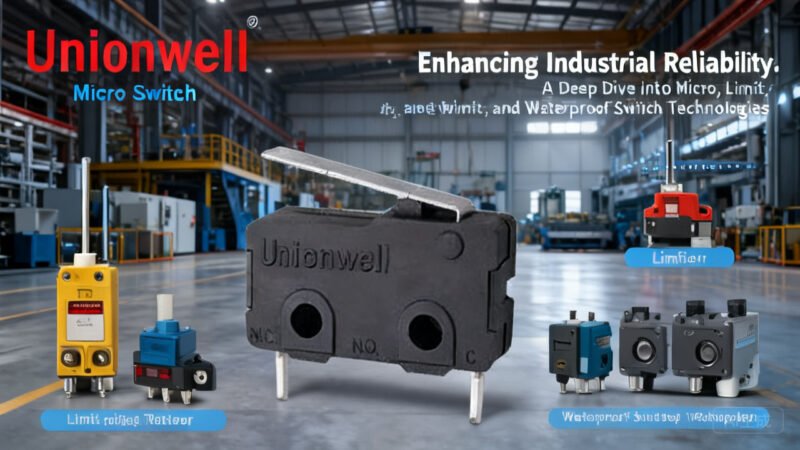
In the intricate world of industrial automation, the reliability and precision of every component are paramount. Among these critical elements, switches stand out as fundamental devices, serving as the eyes and ears of machinery, detecting positions, activating processes, and ensuring safety. The choice of the right switch—be it a micro switch, a limit switch, or a specialized waterproof variant—can significantly impact operational efficiency, system longevity, and overall safety protocols. This article explores the distinct characteristics, applications, and selection criteria for these essential industrial components, highlighting their indispensable role in modern manufacturing and automation.
Micro switches, often referred to as snap-action switches, are compact electromechanical devices renowned for their rapid and decisive actuation. Their defining characteristic is the snap-action mechanism, which ensures a fast, consistent change of state regardless of the speed of the actuator. This rapid switching minimizes arcing and extends the electrical life of the contacts, making them highly reliable for repetitive operations.
Key attributes of micro switches include their high precision, repeatability, and long mechanical life, often exceeding millions of cycles. They come in various configurations, including different actuator types (pin plunger, lever, roller lever) and contact arrangements (normally open, normally closed, changeover). Their small footprint allows for integration into tight spaces, making them ideal for a multitude of applications:
- Automotive: Door interlocks, seatbelt detection, gear shift position sensing.
- Consumer Electronics: Power tools, domestic appliances, security systems.
- Industrial Control Panels: Safety interlocks, position sensing, control circuit activation.
- Medical Devices: Precision control in diagnostic and therapeutic equipment.
The performance of a micro switch is heavily dependent on the quality of its manufacturing. A reputable micro switch manufacturer invests heavily in precision engineering, material science, and rigorous testing to ensure their products deliver consistent performance in demanding environments.
Detecting Position and Presence: Robust Limit Switches
Limit switches are robust electromechanical devices designed to detect the presence, absence, or position of an object in industrial machinery. Unlike micro switches, which prioritize compactness and precision within an enclosed unit, limit switches are typically built for durability and resilience in harsh industrial environments. They often incorporate a micro switch within a more rugged housing, providing enhanced protection against physical impact, dust, and moisture.
Common types of limit switches include:
- Plunger Type: Activated by direct contact with an object.
- Roller Lever Type: Features a roller at the end of a lever, allowing for smoother actuation as objects pass by.
- Rotary Type: Used for detecting rotational movement or angular position.
- Fork Type: Detects objects passing through a slotted opening.
Applications for limit switches are widespread in heavy-duty industrial settings:
- Machine Tools: End-of-travel detection, tool position verification.
- Conveyor Systems: Material flow control, jam detection.
- Robotics: Arm position sensing, safety zone monitoring.
- Material Handling: Pallet presence detection, overhead crane limits.
- Safety Gates: Ensuring gates are closed before machinery operates.
When selecting a limit switch, factors such as operating force, pre-travel, over-travel, and reset force are crucial, alongside environmental considerations like temperature range and vibration resistance.
Conquering Harsh Environments: Waterproof and Sealed Switches
In many industrial applications, switches are exposed to challenging conditions such as moisture, dust, oils, chemicals, and extreme temperatures. For these environments, standard switches are insufficient, necessitating the use of waterproof and sealed switches. A waterproof micro switch, for instance, is specifically designed to prevent the ingress of contaminants, ensuring reliable operation and extended lifespan.
The degree of protection offered by these switches is typically indicated by their Ingress Protection (IP) rating. An IP67 rated switch, for example, is protected against dust ingress and can withstand temporary immersion in water up to 1 meter for 30 minutes. Higher ratings like IP68 offer even greater protection, often allowing for continuous submersion.
Key features of waterproof and sealed switches include:
- Sealed Housings: Constructed from robust materials like plastics or metals, with tight seals.
- Epoxy Potting: Internal components are often potted in epoxy resin for enhanced protection against moisture and vibration.
- O-rings and Gaskets: Used at interfaces to create a watertight seal.
- Corrosion-Resistant Materials: For external components to withstand chemical exposure.
Applications where waterproof switches are indispensable include:
- Outdoor Equipment: Agricultural machinery, construction vehicles, street lighting.
- Marine Applications: Shipboard controls, dockside equipment.
- Food Processing: Equipment requiring frequent washdowns, where hygiene is critical.
- Medical Devices: Sterilizable equipment, patient monitoring systems.
- Hazardous Environments: Where dust or explosive atmospheres are a concern.
The ability of a waterproof micro switch to perform consistently under such conditions is a testament to advanced design and manufacturing processes.
Key Considerations for Switch Selection
Choosing the appropriate switch for an industrial application requires a comprehensive evaluation of several factors:
- Electrical Ratings: Ensure the switch can handle the required voltage and current for both AC and DC loads.
- Mechanical and Electrical Life: Match the switch’s expected lifespan to the application’s operational demands.
- Operating Environment: Consider temperature extremes, humidity, vibration, shock, and exposure to contaminants (dust, water, chemicals). This is where waterproof and sealed options become critical.
- Actuator Type: Select an actuator that aligns with the mechanical interaction in the application (e.g., plunger, roller, lever, push button).
- Mounting Options: Evaluate panel mount, PCB mount, or chassis mount requirements.
- Certifications: Verify compliance with relevant industry standards and safety certifications (e.g., UL, CE, RoHS).
- Repeatability: For precision applications, the switch’s ability to actuate at the exact same point repeatedly is vital.
Partnering with a leading micro switch manufacturer or a specialized limit switch provider ensures access to a wide range of products, technical expertise, and custom solutions tailored to specific industrial needs. Their commitment to quality and innovation translates directly into the reliability and longevity of the final product.
The Manufacturer’s Imperative: Quality and Innovation
The effectiveness of any industrial switch ultimately hinges on the quality and engineering prowess of its manufacturer. Leading manufacturers are characterized by rigorous quality control processes, from raw material inspection to final product testing. They invest in advanced R&D to develop new materials, improve sealing technologies for waterproof micro switch designs, and refine snap-action mechanisms for enhanced precision and durability. Their ability to provide comprehensive technical support and custom design services further cements their value to industrial clients, ensuring that every switch deployed is optimized for its intended purpose and contributes to the overall robustness of the automation system.
Conclusion
Micro switches, limit switches, and their waterproof counterparts are far more than simple on/off devices; they are precision instruments critical to the safety, efficiency, and reliability of modern industrial operations. Understanding their distinct characteristics and carefully considering the application environment are key to informed selection. By choosing high-quality switches from reputable manufacturers, businesses can significantly enhance the performance, longevity, and safety of their machinery, ultimately driving greater productivity and minimizing costly downtime in the dynamic landscape of industrial automation.