
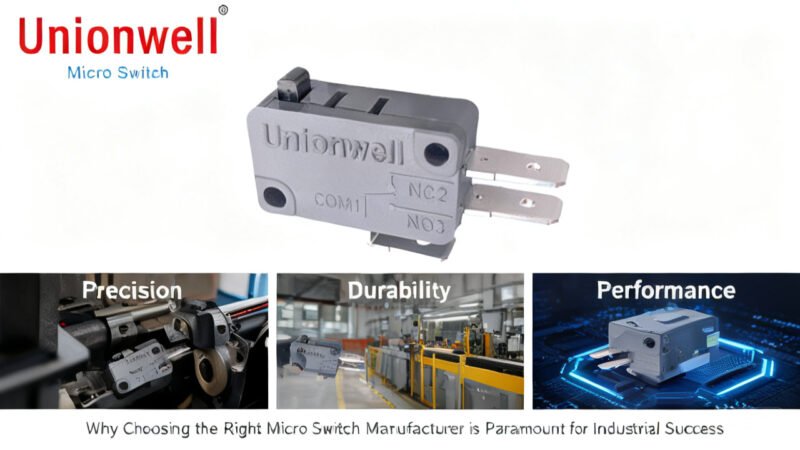
In the intricate world of industrial automation and consumer electronics, some components, though small, wield immense influence over the reliability and performance of entire systems. Among these vital elements is the micro switch – a seemingly simple device that acts as a critical interface between mechanical movement and electrical control. Its snap-action mechanism provides precise, repeatable switching, making it indispensable across a vast spectrum of applications, from heavy machinery to everyday household appliances.
A micro switch, often referred to as a miniature snap-action switch, operates on a principle of rapid contact transfer. When a specific force is applied to its actuator, an internal spring mechanism quickly “snaps” the electrical contacts from one position to another, ensuring a clean break or make. This rapid action minimizes arcing and contact bounce, contributing significantly to a longer operational life and superior electrical performance.
Key characteristics that define a high-quality micro switch include:
- High Repeatability: Consistent actuation and release points, crucial for precision control.
- Fast Switching Speed: Minimizes signal delay and wear on contacts.
- Compact Size: Allows for integration into space-constrained designs.
- Durability: Designed to withstand millions of operational cycles.
- Versatility: Available in numerous configurations regarding actuator types, operating forces, and terminal options.
Specialized Solutions for Demanding Environments: Limit and waterproof micro switches
While the basic micro switch is highly versatile, many industrial applications demand specialized variants built to endure more challenging conditions and perform specific functions.
Limit Switches: Guardians of Automation and Safety
Limit switches are robust versions of micro switches, engineered specifically for industrial environments. Their primary role is to detect the presence or absence of an object, monitor the end-of-travel of a moving part, or verify a specific position within a mechanical system. They are fundamental safety devices and critical components in automation. Imagine a conveyor belt stopping precisely when a product reaches its destination, or a robotic arm knowing its exact coordinates – these are often orchestrated by limit switches.
Features distinguishing industrial limit switches often include:
- Heavy-duty housings (metal or robust plastic) to protect against physical impact, dust, and liquids.
- Enhanced sealing for ingress protection (IP ratings).
- A wide array of actuator styles to suit different sensing requirements (e.g., roller levers, plunger types, rod levers).
- Higher electrical ratings and longer mechanical life cycles suitable for continuous industrial operation.
waterproof micro switches: Defying the Elements
For applications exposed to moisture, dust, oils, or other contaminants, standard micro switches simply won’t suffice. This is where waterproof micro switches become indispensable. These specialized switches are meticulously sealed, often to IP67 or even higher standards, ensuring their internal components remain protected from environmental ingress.
Common applications for waterproof micro switches include:
- Outdoor equipment and machinery (e.g., agricultural vehicles, construction equipment).
- Marine applications.
- Automotive systems (under-hood, door mechanisms).
- Food and beverage processing equipment, where frequent washdowns are necessary.
- Medical devices requiring sterilization or operating in humid environments.
The sealing mechanisms typically involve epoxy potting, O-rings, and specialized housing designs, ensuring reliable operation even when submerged or subjected to high-pressure sprays.
The Pillars of Performance: What Defines a Superior Micro Switch?
The true value of a micro switch lies in its unwavering performance over time. Several factors contribute to the superiority of a well-engineered switch:
- Material Quality: The choice of materials for contacts (e.g., silver alloys for conductivity and arc resistance), terminals (brass, phosphor bronze), and housing (high-grade thermoplastics or metals) directly impacts durability and electrical integrity.
- Precision Engineering: Tight manufacturing tolerances ensure consistent snap-action, minimal differential travel, and predictable operating characteristics throughout the switch’s lifespan.
- Durability and Lifecycle: A superior switch is rated for millions of mechanical and electrical cycles, translating to longer service intervals and reduced maintenance costs.
- Electrical Ratings: The ability to reliably handle specified currents and voltages without degradation is paramount for safety and performance.
- Actuation Flexibility: A range of operating forces and actuator styles (pin plungers, roller levers, simulated roller levers, etc.) allows for optimal integration into diverse mechanical designs.
- Terminal Options: Availability of solder, quick-connect, or PCB terminals provides flexibility for various assembly methods.
The Strategic Advantage: Partnering with an Expert micro switch manufacturer
For B2B clients, selecting the right micro switch is not merely a procurement decision; it’s a strategic partnership that impacts product quality, reliability, and ultimately, market success. A reputable micro switch manufacturer offers far more than just components:
- Rigorous Quality Control: Adherence to international standards (e.g., ISO 9001) and comprehensive in-house testing (lifecycle, environmental, electrical performance) ensures consistent product excellence.
- Design and Engineering Expertise: The ability to offer a broad portfolio of standard products alongside custom-engineered solutions for unique application requirements.
- Reliable Supply Chain: Consistent material sourcing and robust production capabilities guarantee timely delivery and product availability, crucial for managing production schedules.
- Global Certifications: Compliance with international safety and environmental standards such as UL, cUL, ENEC, CQC, RoHS, and REACH is vital for market access and product safety.
- Technical Support and Collaboration: Expert guidance in selecting the optimal switch, understanding application nuances, and providing detailed technical data.
- Commitment to Innovation: Continuous investment in R&D to develop new materials, sealing technologies, and designs that meet evolving industry demands.
Applications Across Industries
The ubiquitous nature of micro switches means they are found in nearly every sector:
- Automotive: Door interlocks, seat position sensors, gear shift mechanisms, power window controls.
- Industrial Automation: Robotics, CNC machinery, safety interlocks, conveyor systems, control panels.
- Home Appliances: Microwaves, washing machines, refrigerators, dishwashers.
- Medical Devices: Infusion pumps, patient monitoring equipment, diagnostic tools.
- HVAC Systems: Airflow sensors, damper controls.
- Aerospace & Defense: Actuator position feedback, cockpit controls.
Conclusion
Micro switches are unsung heroes of modern technology, providing the precise and reliable feedback loops that enable complex systems to function seamlessly. For businesses operating in demanding industries, the choice of a micro switch is critical. It’s not just about the immediate cost of the component, but about the long-term reliability, safety, and operational efficiency it imparts to the final product. Partnering with a manufacturer renowned for its commitment to quality, precision engineering, and comprehensive support is an investment in the enduring success and reputation of your own products. Ensure your critical applications are powered by switches built for performance and longevity – because in the world of industrial reliability, every snap-action counts.