
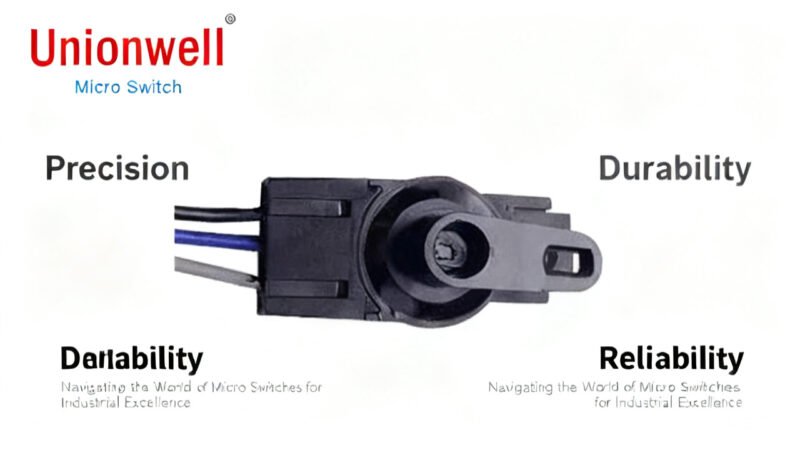
In the intricate landscape of modern industrial and commercial operations, seemingly small components often play the most pivotal roles. Among these unsung heroes, micro switches stand out as critical enablers of precision, safety, and efficiency across countless applications. These diminutive devices, characterized by their snap-action mechanism, are indispensable for detecting position, controlling processes, and ensuring the reliable operation of machinery and systems.
At its heart, a micro switch is a type of electrical switch that is actuated by a very small physical force, using a snap-action mechanism. This mechanism ensures a rapid, decisive change in contact state, regardless of the speed of actuation. This ‘snap-action’ is crucial as it minimizes arcing and contact wear, thereby extending the switch’s operational life and enhancing its reliability. Their design typically involves a lever, roller, or plunger actuator that, when depressed, causes the internal contacts (usually Common, Normally Open, and Normally Closed) to switch states.
Key characteristics that define the utility and performance of micro switches include:
- High Precision and Repeatability: They offer consistent actuation points, vital for applications requiring accurate position sensing.
- Exceptional Durability: Engineered for millions of cycles, making them ideal for high-frequency operations in demanding environments.
- Compact Design: Their small footprint allows for integration into space-constrained assemblies and miniature devices.
- Versatility: Available in a vast array of actuator styles, contact configurations, and electrical ratings to suit diverse application requirements.
- Cost-Effectiveness: Providing high performance and reliability at a competitive price point, contributing to a favorable total cost of ownership.
Specialized Variants for Demanding Environments
While standard micro switches serve a broad spectrum of applications, specific industrial demands necessitate specialized variants built for enhanced robustness and functionality.
The Indispensable Limit Switch
A limit switch is essentially a micro switch housed within a robust enclosure, often designed for industrial-grade durability. Its primary function is to detect the presence or absence of an object, or to monitor the travel limits of moving machinery. They are fundamental to automation, safety interlocks, and process control in manufacturing. Limit switches come in various forms, including plunger, roller lever, and rotary types, each designed for specific actuation methods and environmental conditions. Their heavy-duty construction protects against physical impact, dust, and moisture, making them suitable for harsh factory floors, conveyor systems, and robotic cells. They play a critical role in preventing over-travel, sequencing operations, and ensuring operator safety by detecting abnormal machine positions.
The Imperative of waterproof micro switches
In environments exposed to liquids, dust, or corrosive agents, standard micro switches simply won’t suffice. This is where waterproof micro switches become indispensable. These switches are specifically designed with sealed enclosures and internal components to prevent ingress of contaminants, typically rated according to the Ingress Protection (IP) standard (e.g., IP67, IP68). An IP67 rating, for instance, signifies complete protection against dust and the effects of temporary immersion in water up to 1 meter for 30 minutes.
Waterproof micro switches are crucial in applications such as:
- Outdoor Equipment: HVAC systems, agricultural machinery, traffic control.
- Marine Applications: Shipboard controls, navigation systems, bilge pumps.
- Food & Beverage Processing: Equipment requiring frequent wash-downs.
- Medical Devices: Sterilizable instruments, patient monitoring equipment.
- Automotive: Under-the-hood components, door latches, window mechanisms.
Their ability to maintain operational integrity under adverse conditions ensures continuous performance and prevents costly downtime or safety hazards.
Broadening Horizons: Applications Across Industries
The versatility of micro switches, including their limit and waterproof variants, makes them ubiquitous across a multitude of sectors:
- Industrial Automation: Robotics, CNC machines, conveyor systems, safety interlocks on machine guards.
- Automotive: Door latches, seat belt detection, gearshift interlocks, brake light activation.
- Consumer Appliances: Microwaves, washing machines, refrigerators, HVAC units, coffee makers.
- Medical Devices: Diagnostic equipment, hospital beds, drug delivery systems, surgical tools.
- Aerospace & Defense: Landing gear position sensing, cockpit controls, missile systems.
- Building Automation: Access control systems, elevator controls, security systems.
Selecting the Optimal micro switch manufacturer
For B2B buyers and engineers, choosing the right micro switch manufacturer is as critical as selecting the switch itself. A reliable manufacturer acts as a strategic partner, ensuring the quality, availability, and suitability of components for your specific applications. Key considerations include:
- Quality Assurance & Certifications: Look for manufacturers with rigorous quality control processes and international certifications such as ISO 9001, UL, CE, and RoHS compliance. These attest to product reliability and adherence to global standards.
- R&D and Customization Capabilities: The ability to develop tailored solutions for unique application requirements, including custom actuators, contact materials, or environmental sealing, is invaluable. Leading manufacturers, for example, often offer extensive customization options for their micro switches and limit switches.
- Technical Support & Expertise: A manufacturer that provides robust pre-sales and post-sales support, including design assistance, application engineering, and troubleshooting, can significantly streamline your development process.
- Supply Chain Reliability: Consistent product availability, on-time delivery, and the capacity to scale production for large orders are crucial for maintaining operational continuity.
- Product Range and Innovation: A broad portfolio, encompassing standard, limit, and waterproof micro switches, indicates a comprehensive understanding of market needs and a commitment to continuous innovation.
- Total Cost of Ownership: Beyond the unit price, consider the longevity, reliability, and support offered by the manufacturer, which collectively impact the long-term cost-effectiveness of your systems.
The Future of Micro Switch Technology
The evolution of micro switch technology continues, driven by demands for greater miniaturization, enhanced environmental resilience, and integration into smarter, more connected systems. Innovations are focusing on even higher durability, broader operating temperature ranges, and capabilities for integration with IoT platforms, offering diagnostic data and predictive maintenance insights.
Conclusion
Micro switches, in all their forms – from standard snap-action devices to robust limit switches and resilient waterproof variants – are foundational components driving the efficiency, safety, and reliability of countless industrial and commercial systems. Their seemingly small size belies their immense impact on modern technology. For businesses seeking to optimize their operations and build high-performance products, partnering with a reputable micro switch manufacturer is not merely a procurement decision but a strategic investment in quality, innovation, and long-term success.