
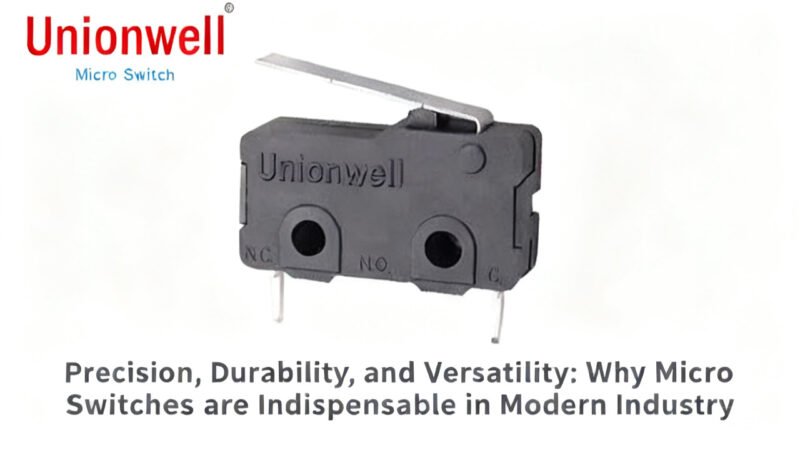
In the intricate world of industrial automation, consumer electronics, and countless other applications, the seemingly small micro switch plays a monumental role. These compact, high-precision devices are the unsung heroes responsible for detecting position, ensuring safety, and enabling the precise control that underpins modern machinery and systems. For engineers, product designers, and procurement specialists, understanding the nuances of micro switches – from standard models to specialized limit and waterproof variants – is crucial for optimizing performance, reliability, and safety.
At its core, a micro switch is a snap-action electrical switch characterized by its small size and precise operation. It typically consists of a spring-loaded lever or plunger that, when actuated by a minimal force, rapidly changes the state of electrical contacts (from normally open to normally closed, or vice-versa). This “snap-action” mechanism ensures a quick make-or-break, minimizing arcing and extending the switch’s operational life. Their inherent design provides high repeatability and accuracy, making them ideal for applications requiring consistent and reliable switching.
Key Advantages Driving Their Widespread Adoption
- Exceptional Precision and Repeatability: Micro switches offer extremely consistent operating points, critical for precise control in automation and sensing.
- High Durability and Long Cycle Life: Engineered for millions of operations, they provide long-term reliability even in demanding environments.
- Compact Size: Their small footprint allows integration into confined spaces, crucial for miniaturized devices and complex machinery.
- Versatility in Actuation: Available with various actuators (pin plunger, hinge lever, roller lever, etc.), they can be tailored to specific mechanical interface requirements.
- Robust Electrical Performance: Capable of handling significant electrical loads, ensuring reliable power switching.
Specialized Variants: Limit Switches and waterproof micro switches
Limit Switches: The Sentinels of Position Sensing
A limit switch is essentially a robust and often larger-housed micro switch designed specifically for detecting the presence or absence of an object, or for monitoring the limits of motion for a machine part. They are fundamental components in industrial automation, serving as critical safety devices and control inputs. Encased in durable housings, limit switches are built to withstand harsh industrial environments, including exposure to dust, debris, coolant, and mechanical shock. Their heavy-duty construction and precise snap-action mechanism make them indispensable for:
- Machine Tool Control: Ensuring components reach their designated positions.
- Conveyor Systems: Detecting product presence or jam conditions.
- Safety Interlocks: Preventing machine operation if guards are open or parts are out of place.
- Automated Doors and Gates: Sensing open/closed positions.
The reliability of a limit switch directly impacts the safety and efficiency of an entire system, highlighting the importance of sourcing from reputable micro switch manufacturers.
waterproof micro switches: Engineered for Extreme Environments
Not all applications occur in clean, dry conditions. For environments exposed to liquids, dust, or extreme temperatures, waterproof micro switches are essential. These specialized switches incorporate advanced sealing technologies, often achieving high Ingress Protection (IP) ratings (e.g., IP67, IP68), which certify their resistance to dust ingress and immersion in water. This makes them ideal for:
- Outdoor Equipment: Vending machines, traffic control systems.
- Automotive Applications: Door latches, engine compartment sensors.
- Marine Equipment: Bilge pumps, navigation systems.
- Industrial Machinery: Where washdowns or coolant exposure are common.
- Medical Devices: Requiring sterilization or resistance to bodily fluids.
The integrity of the sealing mechanism is paramount in waterproof micro switches, making material selection and manufacturing precision critical factors.
Critical Applications Across Industries
The versatility of micro switches, including their limit and waterproof variants, makes them indispensable across a vast array of sectors:
- Automotive: Door latches, seat belt detection, gear shift interlocks, power window controls.
- Home Appliances: Microwave ovens (door interlocks), washing machines (lid switches), refrigerators (ice makers).
- Industrial Automation: Robotics, CNC machines, safety gates, material handling.
- Medical Devices: Patient beds, diagnostic equipment, infusion pumps.
- HVAC Systems: Damper control, fan speed detection.
- Aerospace: Landing gear position sensing, cockpit controls.
- Security Systems: Tamper detection, access control.
Selecting the Right Micro Switch: A Guide for Professionals
Choosing the optimal micro switch requires careful consideration of several factors to ensure performance, longevity, and compliance:
- Electrical Ratings: Match the switch’s voltage and current ratings to the application’s requirements to prevent premature failure.
- Operating Force: Determine the maximum and minimum force available from the actuating mechanism.
- Actuator Type: Select an actuator (e.g., pin plunger, roller lever, short hinge lever) that interfaces correctly with the mechanical system.
- Terminal Configuration: Choose between solder, quick-connect, screw, or wire lead terminals based on assembly methods.
- Environmental Conditions: Consider temperature range, presence of dust, moisture, chemicals, and vibration. This is where waterproof micro switches and robust limit switches become critical.
- Mechanical Life: Specify a switch with a mechanical life cycle sufficient for the expected operational demands.
- Certifications: Ensure the switch meets relevant industry standards (e.g., UL, CUL, ENEC, CQC) for safety and quality.
- Manufacturer Reputation: Partnering with a proven micro switch manufacturer ensures access to high-quality products, consistent supply, and expert technical support.
The Importance of a Trusted Micro Switch Manufacturer
The reliability of an entire system often hinges on the quality of its smallest components. A reputable micro switch manufacturer invests heavily in research and development, stringent quality control, and advanced manufacturing processes. They offer a comprehensive product portfolio, including standard, limit, and waterproof micro switches, often with customization options to meet unique application challenges. Such manufacturers provide not just components, but also expertise and support, ensuring that engineers and designers can integrate these critical switches with confidence.
Conclusion
Micro switches, in all their forms – from the standard snap-action device to the rugged limit switch and the sealed waterproof variant – are foundational elements in modern engineering. Their ability to deliver precise, repeatable, and reliable electrical switching in a compact form factor makes them indispensable. By carefully selecting the right type of switch and partnering with an experienced micro switch manufacturer, industries can ensure the optimal performance, safety, and longevity of their products and systems. The future of automation and control will continue to rely heavily on these small but mighty components, pushing the boundaries of what’s possible with precision engineering.