
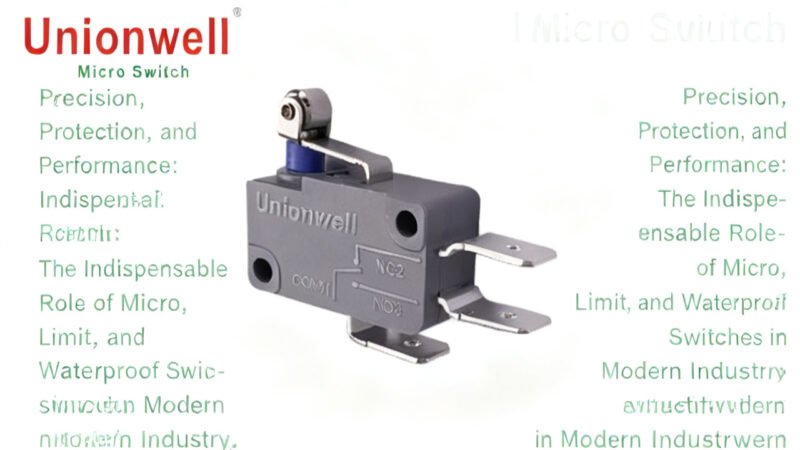
In the intricate world of industrial automation, consumer electronics, and specialized machinery, the reliability of a single component can dictate the success or failure of an entire system. Among these critical components, micro switches, limit switches, and their specialized waterproof counterparts stand out as indispensable workhorses, providing precise control, robust safety, and unwavering performance even in the most demanding environments.
At its core, a micro switch, often referred to as a miniature snap-action switch, is an electrical switch actuated by very little physical force, utilizing a tipping-point mechanism. This mechanism results in a rapid, decisive transfer of contacts from one state to another, regardless of the speed of actuation. This “snap-action” is crucial for preventing arcing and ensuring consistent, reliable operation over millions of cycles. Key characteristics include:
- High Precision: Accurate and repeatable actuation points.
- Durability: Designed for an exceptionally long mechanical and electrical life.
- Compact Size: Enables integration into space-constrained applications.
- Versatility: Available in numerous configurations for various electrical loads and operating forces.
From the simple door interlock in a microwave oven to complex control systems in aerospace, micro switches provide the fundamental on/off signaling that underpins countless operations.
The Guardian of Machinery: Limit Switches
Building upon the principle of micro switches, limit switches serve a vital role in industrial control and automation. A limit switch is an electromechanical device that consists of an actuator mechanically linked to a set of contacts. When an object (the “target”) comes into contact with the actuator, it causes the contacts to change state, thereby signaling the presence or absence of the object, or indicating that a mechanical motion has reached its limit.
Their primary functions include:
- Position Sensing: Detecting the position of moving parts in machinery.
- Counting: Registering the number of items passing a point.
- Safety Interlocks: Preventing machinery from operating under unsafe conditions (e.g., a guard being open).
- Sequence Control: Initiating the next step in an automated process.
Limit switches are robust, reliable, and come in various actuator styles (plunger, roller lever, rod lever) to suit diverse mechanical interfaces. They are the eyes and ears of automated systems, ensuring processes run smoothly and safely.
Conquering Harsh Environments: waterproof micro switches
While standard micro and limit switches excel in controlled environments, many industrial and outdoor applications expose components to moisture, dust, oils, and other contaminants. This is where waterproof micro switches become not just an advantage, but a necessity.
A waterproof micro switch is specifically engineered with enhanced sealing mechanisms to protect its internal contacts from ingress of liquids and particulates. This protection is quantified by an Ingress Protection (IP) rating, with common ratings for waterproof switches ranging from IP67 (dust tight and protected against immersion up to 1 meter for 30 minutes) to even higher levels. Key benefits include:
- Enhanced Reliability: Prevents short circuits and corrosion caused by moisture.
- Extended Lifespan: Protects internal components from wear and tear due to contaminants.
- Operational Continuity: Ensures consistent performance in challenging conditions.
- Safety Compliance: Meets regulatory requirements for equipment used in wet or dusty environments.
Applications range from automotive door latches and industrial washing equipment to outdoor security systems, marine equipment, and even medical devices that require sterilization.
Key Considerations for Selection and Application
Choosing the right switch involves a careful evaluation of several factors:
1. Electrical Ratings
- Voltage and Current: Ensure the switch can safely handle the maximum voltage and current of the circuit. Both AC and DC ratings are important.
- Load Type: Inductive, resistive, or capacitive loads have different characteristics that affect contact life.
2. Mechanical Specifications
- Operating Force: The force required to actuate the switch.
- Actuator Type: Plunger, lever, roller, simulated roller – chosen based on the mechanical interface.
- Pre-Travel, Overtravel, Differential Travel: Critical for precise positioning and reliable operation.
- Mechanical Life: The number of cycles the switch can withstand.
3. Environmental Factors
- Temperature Range: Operating and storage temperatures must be within the switch’s specifications.
- IP Rating: Essential for applications exposed to dust, water, or other liquids.
- Vibration and Shock Resistance: Important for mobile or heavy machinery applications.
4. Material and Construction
- Contact Material: Affects electrical performance and lifespan (e.g., silver alloy for general use, gold plating for low current).
- Housing Material: Influences durability and resistance to chemicals or extreme temperatures.
5. Regulatory Compliance
Adherence to international standards such as UL, cUL, ENEC, and CE is crucial for market acceptance and safety.
Applications Across Diverse Industries
The ubiquity of these switches is staggering. They are found in:
- Automotive: Door latches, seat belt sensors, gear shifters, power window controls.
- Industrial Machinery: Conveyor systems, robotics, CNC machines, safety gates, assembly lines.
- Home Appliances: Microwaves, washing machines, refrigerators, HVAC systems.
- Medical Devices: Hospital beds, diagnostic equipment, infusion pumps.
- Aerospace: Landing gear position sensing, cabin door interlocks.
- Security Systems: Access control, anti-tamper devices.
- Vending Machines: Coin mechanisms, product delivery systems.
The Imperative of Quality and Reliability
In a world where downtime can cost millions and safety is paramount, the choice of a switch manufacturer is critical. A high-quality micro switch, limit switch, or waterproof variant ensures not only the immediate functionality of a product but also its long-term reliability, reducing maintenance costs, enhancing user safety, and protecting brand reputation. Investing in components from reputable manufacturers known for their stringent quality control, extensive testing, and innovative designs is an investment in the overall success and longevity of any application.
These unassuming components are the silent workhorses enabling the precision, safety, and efficiency demanded by today’s advanced technologies. Understanding their capabilities and selecting the right switch for the job is fundamental to engineering robust and reliable systems.