
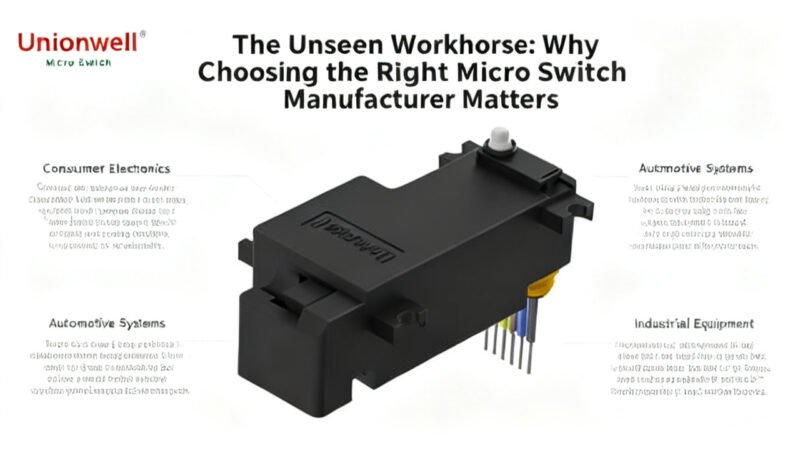
In the vast landscape of industrial automation, consumer electronics, and specialized machinery, certain components operate tirelessly behind the scenes, ensuring precision, safety, and reliability. Among these unsung heroes is the micro switch – a small but mighty device critical for countless applications. For businesses and engineers, understanding the nuances of these components and, more importantly, selecting the right micro switch manufacturer is paramount to product success and operational efficiency.
Understanding the Micro Switch
At its heart, a micro switch is a snap-action electrical switch, known for its rapid change in contact state from one position to another with a small amount of movement at the actuator. This ‘snap-action’ mechanism provides several key advantages:
- High Repeatability: Consistent actuation point, crucial for precision applications.
- Fast Switching: Minimizes arc time, extending switch life and reducing electrical noise.
- Tactile Feedback: A distinct ‘click’ often indicates successful operation.
- Compact Size: Enables integration into tight spaces.
These characteristics make micro switches indispensable in everything from automotive systems and industrial control panels to home appliances and medical devices.
The Pivotal Role of a micro switch manufacturer
The quality and performance of a micro switch are directly tied to its manufacturer. A reputable micro switch manufacturer doesn’t just produce components; they engineer solutions. This involves:
- Material Science Expertise: Selecting the right contact materials (e.g., silver alloy, gold plating) for specific electrical loads and environmental conditions.
- Precision Engineering: Designing robust mechanisms that withstand millions of cycles without degradation.
- Rigorous Testing: Implementing comprehensive quality control processes, including electrical, mechanical, and environmental testing, to ensure reliability and compliance with international standards (UL, CE, RoHS, CQC).
- Innovation and R&D: Continuously developing new designs, materials, and manufacturing techniques to meet evolving industry demands, such as miniaturization and enhanced environmental resistance.
- Customization Capabilities: Offering tailored solutions for unique application requirements, from specific operating forces to custom terminal configurations.
Partnering with an experienced manufacturer ensures access to technical support, reliable supply chains, and components that perform consistently in demanding environments.
Limit Switches: Precision in Position Detection
A specialized and widely used application of micro switch technology is the limit switch. Essentially, a limit switch is an electromechanical device that detects the presence or absence of an object or the passing of an object beyond a certain point. It physically contacts the object (or a part of it) to actuate its internal switch mechanism.
Limit switches are vital for:
- Position Sensing: Determining the end-of-travel for machinery, such as robotic arms, conveyor belts, and gate openers.
- Safety Interlocks: Preventing machinery from operating if guards are open or if parts are misaligned.
- Counting and Sequencing: Triggering actions based on the movement or presence of components in an assembly line.
They come with various actuator types—plunger, roller lever, rod lever, and more—to suit different detection methods and operating environments. The internal snap-action mechanism of the micro switch ensures precise and repeatable tripping of the limit switch.
The Imperative of waterproof micro switches
Many industrial and outdoor applications expose electronic components to harsh conditions, including moisture, dust, oils, and corrosive agents. In such scenarios, a standard micro switch simply won’t suffice. This is where the waterproof micro switch becomes indispensable.
Designed with enhanced sealing techniques, often achieved through epoxy potting, O-rings, or specialized housing materials, waterproof micro switch models boast high Ingress Protection (IP) ratings, commonly IP67 or IP68. An IP67 rating, for instance, means the switch is completely protected against dust ingress and can withstand temporary immersion in water up to 1 meter for 30 minutes.
Applications for waterproof micro switch technology include:
- Outdoor equipment (e.g., irrigation systems, vending machines, security cameras).
- Marine and automotive environments.
- Food processing and beverage equipment (where frequent washdowns occur).
- Medical devices requiring sterilization.
- Industrial machinery operating in dusty or wet conditions.
The reliability of a waterproof micro switch in these environments directly impacts the longevity and safety of the entire system.
Innovation and Reliability: The Unionwell Perspective
When discussing reliable micro switch solutions, companies like Unionwell stand out as examples of dedicated micro switch manufacturer firms. A unionwell micro switch, for instance, typically embodies a commitment to precision engineering, rigorous testing, and a diverse product portfolio. They often focus on delivering robust, long-lasting components, including miniature micro switches, basic switches, and specialized waterproof micro switch series, designed to meet stringent industry standards and application-specific needs. Their approach highlights the importance of consistent quality and innovation in an ever-evolving market.
Key Considerations for Micro Switch Selection
Selecting the right micro switch for your application requires careful evaluation of several factors:
- Electrical Ratings: Voltage, current, and load type (resistive, inductive, lamp).
- Mechanical Life: The expected number of operations before failure, critical for high-cycle applications.
- Operating Force: The force required to actuate the switch, impacting user interface and mechanism design.
- Actuator Type: Plunger, lever, roller, etc., chosen based on the mechanism it interacts with.
- Environmental Resistance: Temperature range, vibration, shock, and IP rating for dust and moisture protection.
- Terminal Options: Solder terminals, quick-connect terminals, wire leads.
- Certifications: Ensuring compliance with relevant safety and environmental standards (e.g., UL, CE, RoHS).
- Customization: The ability of the micro switch manufacturer to adapt standard products or design new ones for unique requirements.
The Future of Micro Switch Technology
The demand for micro switches continues to evolve. Future trends point towards further miniaturization, enhanced sensing capabilities, integration into smart systems, and an even greater emphasis on performance in extreme environments. As industries push the boundaries of automation and connectivity, the role of reliable, high-performance micro switches will only become more critical.
Conclusion
Micro switches, whether as standalone components or integrated into limit switch assemblies or designed as a robust waterproof micro switch, are fundamental to the functionality and safety of countless devices and systems. Their small size belies their immense impact on reliability and precision. For businesses, the strategic decision to partner with a reputable and experienced micro switch manufacturer, such as those that uphold the standards seen in a unionwell micro switch, is not merely about procurement; it’s about investing in the long-term performance, safety, and success of their products and operations. Choosing wisely ensures that the unseen workhorse continues to perform flawlessly, driving innovation and efficiency across industries.