
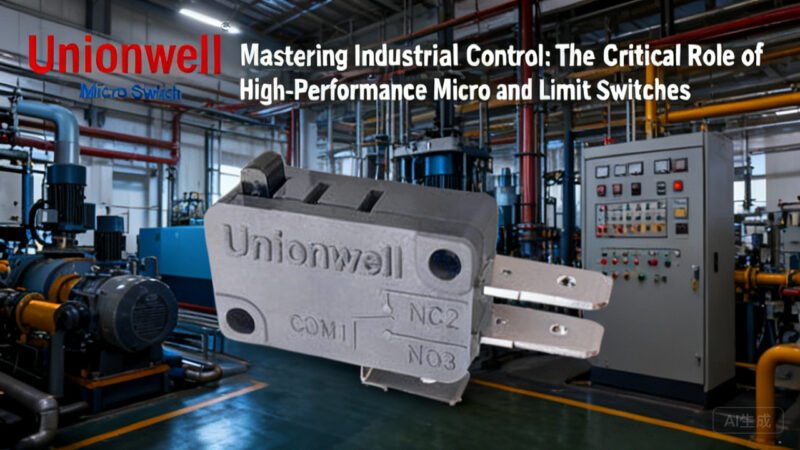
In the intricate world of industrial automation and control, micro switches and limit switches are critical for precision, safety, and efficiency. These unassuming devices detect positions, confirm states, and trigger actions across countless applications, from small appliances to heavy machinery. For B2B stakeholders, understanding their nuances, applications, and the importance of choosing high-quality components from a reputable micro switch manufacturer is paramount to operational success.
Micro Switches: Precision in a Compact Package
A micro switch, or “snap-action switch,” is a small, highly sensitive device requiring minimal pressure to operate. Its defining snap-action mechanism ensures a rapid, decisive change in contact state, minimizing arcing and extending electrical life. This design provides high repeatability, making them ideal for precision applications like medical equipment and assembly lines. Their compact size allows integration into tight spaces, and their long mechanical life (millions of cycles) ensures durability in continuous operation. Micro switches are indispensable for safety interlocks, level detection, and precise feedback in various control systems.
Limit Switches: The Sentinels of Position and Safety
A limit switch is a robust, often larger device designed for industrial environments to detect an object’s presence or monitor its travel limits. When an object contacts its actuator, internal contacts change state, signaling the control system. Key attributes include exceptional durability against shock, vibration, and extreme temperatures, often housed in protective metal casings. They offer a wide variety of actuators (plungers, rollers, levers) to suit diverse contact methods and are capable of handling higher electrical loads than typical micro switches. Limit switches are integral to machine safety, automation, and process control, found on conveyors, machine tools, and material handling equipment, ensuring machinery operates within safe and predefined parameters.
The Critical Role of waterproof micro switches in Challenging Environments
Many industrial applications expose switches to moisture, dust, oils, chemicals, and direct water spray. In these demanding scenarios, standard switches quickly fail, leading to costly downtime and safety hazards. This is where the waterproof micro switch becomes essential. Engineered with advanced sealing mechanisms, often adhering to stringent IP ratings (e.g., IP67, IP68), these switches prevent contaminant ingress. Benefits include extended lifespan, enhanced reliability, reduced maintenance, and improved safety by preventing electrical shorts and malfunctions. Applications span outdoor equipment, marine vessels, food processing plants (with frequent washdowns), automotive systems, and industrial machinery exposed to coolants or cleaning agents. Choosing a high-quality waterproof micro switch from a reputable manufacturer ensures robust, long-lasting sealing integrity.
Selecting the Right Switch for Your Application
Choosing the optimal micro or limit switch requires careful consideration of several factors. First, match electrical requirements (voltage, current, load type) to prevent premature wear. Second, select the appropriate actuator type (plunger, lever, roller) based on the application’s physical interaction. Third, assess the operating force needed for actuation. Fourth, evaluate environmental conditions (temperature, dust, moisture, chemicals, vibration) to determine the necessary IP rating and construction materials. Fifth, consider mechanical and electrical life cycles for long-term reliability. Finally, ensure compliance with international certifications (UL, CE, RoHS) and confirm physical dimensions and mounting options fit your equipment. A professional micro switch manufacturer provides detailed datasheets and expert support to ensure optimal selection.
The Future of Industrial Control: Smart Switches and IoT Integration
As industries embrace Industry 4.0 and the Industrial Internet of Things (IIoT), micro and limit switches are evolving. Manufacturers are integrating smart features like diagnostic capabilities and digital communication protocols (e.g., IO-Link) to provide real-time data on switch health and operational status. This enables predictive maintenance, reducing downtime and enhancing overall system efficiency. High-quality switches form the bedrock of reliable automation, ensuring precise feedback and robust operation for complex machinery. Investing in superior components from a trusted micro switch manufacturer is a strategic decision for the long-term performance, safety, and profitability of industrial operations. These fundamental devices, from snap-action micro switches to heavy-duty limit switches, are crucial for operational excellence in an increasingly automated and data-driven world.