
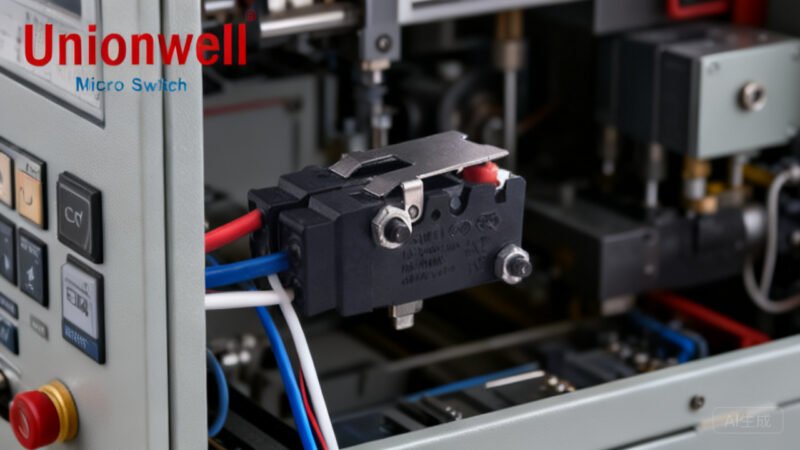
In the intricate machinery of modern industrial automation, countless components work in concert to ensure seamless operation, safety, and efficiency. Among these, micro switches stand out as critical, albeit often unseen, heroes. These small yet powerful devices are fundamental to the control and monitoring of mechanical movements, providing the precise feedback loops that drive everything from simple consumer electronics to complex robotic systems and heavy-duty industrial equipment. For engineers, product designers, and procurement professionals, understanding the nuances of micro switches, including specialized variants like limit switches and waterproof models, is paramount to selecting the right components for optimal performance and longevity.
Micro switches, characterized by their snap-action mechanism, offer rapid and reliable switching with minimal force. This makes them ideal for applications requiring high precision and durability. Their compact size allows for integration into tight spaces, while their robust construction ensures millions of operational cycles. The reliability of a micro switch directly impacts the safety and efficiency of the system it controls, making the choice of manufacturer and product specification a decision of significant consequence.
Limit Switches: Guardians of Mechanical Boundaries
A specialized category within micro switches, limit switches are indispensable for defining and monitoring the operational boundaries of moving parts in machinery. They detect the presence or absence of an object, the position of a moving component, or the end of a mechanical travel path. In essence, they act as mechanical sensors, providing critical input to control systems.
Consider their application in manufacturing lines: a limit switch might detect when a product has reached a specific point on a conveyor belt, triggering the next stage of the assembly process. In robotics, they prevent over-extension of arms or ensure components are correctly seated before an operation begins. For safety, they can immediately halt machine operation if a guard is opened or if a moving part exceeds its safe travel limits, protecting both equipment and personnel.
Key characteristics of high-quality limit switches include their mechanical life, operating force, pre-travel, over-travel, and differential travel. Manufacturers like Unionwell focus on engineering these parameters to meet the stringent demands of diverse industrial environments, ensuring consistent performance even under continuous, rigorous use. The choice of actuator type (e.g., plunger, roller lever, flexible rod) is also critical, tailored to the specific mechanical interaction required.
Conquering Harsh Environments: The Power of waterproof micro switches
Not all industrial environments are clean and controlled. Many applications expose electronic components to moisture, dust, oils, and other contaminants that can quickly degrade standard switches. This is where waterproof micro switches become not just an advantage, but a necessity.
Waterproof micro switches are engineered with advanced sealing technologies, often achieving high Ingress Protection (IP) ratings such as IP67 or IP68. An IP67 rating, for instance, signifies that the switch is completely protected against dust ingress and can withstand immersion in water up to 1 meter for 30 minutes. This level of protection is crucial for outdoor equipment, marine applications, automotive systems, industrial washing equipment, and food processing machinery, where hygiene and resistance to cleaning agents are paramount.
The robust construction of waterproof switches typically involves specialized casing materials, O-rings, and epoxy potting to encapsulate the internal switching mechanism, preventing the ingress of liquids and particulates. This enhanced durability ensures reliable operation in conditions where conventional switches would fail, preventing costly downtime and maintenance, and significantly extending the lifespan of the equipment. When specifying waterproof switches, it’s vital to consider not only the IP rating but also chemical compatibility, temperature range, and vibration resistance to ensure the switch can endure the specific challenges of its intended environment.
Selecting the Right micro switch manufacturer: A Strategic Decision
The performance and longevity of your industrial systems are directly tied to the quality of their components. Therefore, choosing the right micro switch manufacturer is a strategic decision that goes beyond mere cost. A reputable manufacturer offers a combination of product excellence, technical support, and industry expertise.
When evaluating potential partners, consider the following:
- Quality and Reliability: Look for manufacturers with a proven track record of producing switches that meet international standards (e.g., UL, CUL, ENEC, CQC). Rigorous testing protocols, robust material selection, and precision manufacturing processes are hallmarks of quality.
- Diverse Product Portfolio: A comprehensive range of micro switches, limit switches, and waterproof options, along with various actuator types, current ratings, and terminal options, indicates a manufacturer’s capability to meet diverse application needs.
- Customization Capabilities: For unique applications, the ability to customize switch characteristics (e.g., operating force, lever length, wiring harnesses) can be invaluable.
- Technical Support and R&D: Access to experienced engineers for design consultation and problem-solving, coupled with a commitment to research and development, ensures you’re partnering with an innovator.
- Supply Chain Stability: A reliable manufacturer can guarantee consistent product availability and timely delivery, minimizing disruptions to your production schedule.
- Cost-Effectiveness: While not the sole determinant, a balance between high quality and competitive pricing ensures long-term value.
The evolution of industrial automation continues to demand higher levels of precision, durability, and adaptability from its components. Micro switches, in all their forms, are at the forefront of this evolution. By understanding their critical functions and carefully selecting a manufacturer that aligns with your quality and performance requirements, you ensure the foundational reliability necessary for advanced industrial operations.
The Future of Control: Innovation in Micro Switches
As industries move towards more intelligent and interconnected systems (Industry 4.0, IoT), the role of micro switches is also evolving. Future innovations will likely focus on even greater miniaturization, enhanced sensor integration, and the ability to withstand increasingly extreme conditions, all while maintaining their core values of precision and reliability. Partnering with a forward-thinking manufacturer ensures access to these advancements, keeping your operations competitive and robust.